
What it is
Play Therapy is a therapeutic approach that uses play and the creative arts as its main medium to help children express, understand, and process their experiences, thoughts, and emotions.
Unlike talking therapy for adults, children are not asked to sit still, explain their problems, or describe their feelings directly. Through games, stories, symbols, drawings, movement, sand, clay, role play, music, and puppets, a child can express experiences they cannot yet put into words.
Play Therapy is especially relevant for children who are not yet able, find it hard, or do not want to talk directly about what they are going through.
What Can Play Therapy Help With?
Play Therapy can be considered when a child is struggling with emotional, behavioral, relational, or psychological well-being, for example:
- difficulty recognizing or expressing emotions,
- anxiety, fears, or emotional outbursts,
- aggressive behavior, or the opposite, withdrawing,
- low self-confidence,
- difficulty in relationships with peers or adults,
- coping with change, loss, or grief,
- stressful or traumatic experiences,
- difficulty adjusting to school,
- difficulty communicating needs.
Play Therapy does not focus on diagnosis alone. Two children with the same diagnosis can have very different experiences, emotional needs, and therapeutic processes. Therapy is based on each child's individual needs.
Play Is the Language of the Child
Adults process experiences through conversation. For a child, the ability to notice an inner experience, connect it to an emotion, and explain it in words may not yet be fully developed. Repeatedly asking "Why are you angry?" or "Tell me what happened" does not always lead to meaningful communication.
In Play Therapy, the child does not always have to explain. They can show rather than tell. Experiences surface as symbols, stories, characters, repeated play, movement, drawings, or the way the child interacts with the therapist. Play Therapists are trained to follow that process without rushing the child to explain.
How Does Play Therapy Work?
Play Therapy is not simply providing toys and letting a child play. Within a session there is a therapeutic relationship, structure, safe boundaries, consistency, clinical observation, and a therapeutic process led by a trained Play Therapist.
The child has access to a range of media: miniature figures, a sandtray, clay, drawing and painting, dolls and puppets, role play, storytelling, music, movement, therapeutic games, and construction toys. A child may use one medium over and over, move between them, play in silence, or at some point choose to talk. There is no expectation that every session must produce a particular story.
A Non-Directive Approach
Play Therapy at Temenos is grounded mainly in non-directive play therapy within the integrative PTUK/PTI framework. The child leads the play within safe boundaries: choosing what to play, which media to use, whether or not to talk, and how quickly to bring an experience into therapy.
The therapist's role is not passive. The therapist is fully present, builds the relationship, reflects the child's experience, observes play patterns, holds safe boundaries, and responds therapeutically as needed. A trained therapist can also move toward a more directive approach when clinically appropriate, guided by assessment, the therapeutic process, clinical reasoning, and supervision.
The Play Therapy Dimensions Model (PTDM)
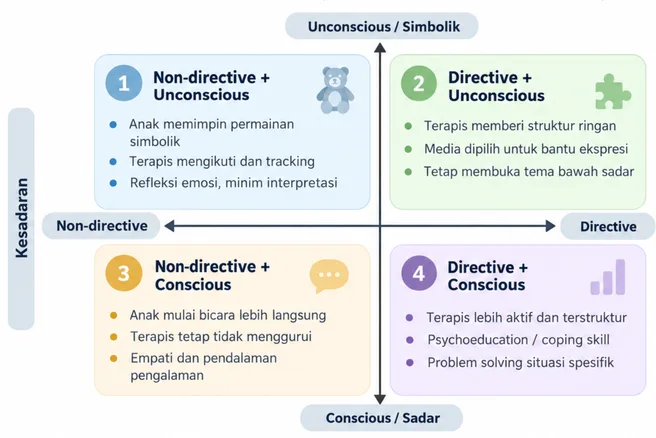
One framework used in PTUK/PTI practice and applied at Temenos is the Play Therapy Dimensions Model, developed by Lorri Yasenik and Ken Gardner. It views the therapeutic process along two dimensions:
- Directiveness
- How far the process is led by the child or by the therapist.
- Consciousness
- How close the process is to the child's awareness: emerging symbolically through story and play, or beginning to be talked about directly.
Combining the two gives four areas that help the therapist make clinical decisions. A child may be highly symbolic in one session and begin to speak more consciously in the next. The therapist follows that development without forcing the child's process.
Play Therapy for Children with Special Needs
Play Therapy is also relevant for children with special needs, especially when speech is limited or communicating emotional experiences directly is hard. For some children with developmental differences or communication difficulties, being asked to explain through conversation is itself a barrier.
Play Therapy gives children many ways to communicate and express themselves: movement, sensory and symbolic play, drawings, color, clay, figures, role play, stories, gesture, expression, and the relationship formed with the therapist. Limited speech does not mean a child has nothing to say.
A Safe Relationship, Regular Attendance
The most important part of Play Therapy is not the toys but the relationship between child and therapist: consistent, accepting, non-judgmental, predictable, emotionally available, and held within safe boundaries. Through that relationship, a child gradually feels safe enough to show parts of themselves that are hard to show elsewhere.
That is why PTUK recommends regular sessions, generally once a week, at the same time and place, with the same therapist. Consistency is part of the therapy. Frequently missed sessions or constantly changing schedules can disrupt the continuity of the process. Change is also not always visible after one or two sessions; every child moves at their own pace, and some need time to feel safe and comfortable before engaging more deeply.
What We Aim to Help Develop
Through a consistent process, Play Therapy aims to support children in:
- expressing and understanding their emotions more safely,
- developing emotional literacy and regulation,
- finding more adaptive ways to face difficulties,
- building self-awareness, confidence, and a sense of agency,
- developing relationship skills and communicating their needs,
- processing difficult experiences and building resilience.
Benefits and goals differ for every child, and progress is evaluated individually.
More Than Play
From the outside, a Play Therapy session may look like a child drawing, playing in sand, or playing with dolls. Behind it, a much deeper process is taking place. At Temenos, we believe children do not always need more questions in order to tell their story. Sometimes what they need is a safe space, a relationship they can trust, enough time, and the freedom to find their own way to communicate.
References
- Play Therapy UK. (n.d.). In depth information on how Play Therapy works. Read the source.
- Yasenik, L., & Gardner, K. (2023). Play therapy dimensions model: New insights for integrative play therapists (3rd ed.). Jessica Kingsley Publishers. Publisher listing.