
What it is
Educational Therapy is an individual intervention service for children, teens, and adults who experience challenges with learning and everyday functioning.
Unlike conventional academic instruction, Educational Therapy looks not only at what is hard to learn, but at why learning becomes hard, and which skills need to grow so a person can learn and function more effectively.
Educational Therapists design interventions from relevant academic, social, emotional, psychological, and neuropsychological information. Interventions can support academic, social, emotional, behavioral, attentional, metacognitive, and executive-functioning development (Marshall & Rotter, 2023).
More Than Academics
Educational Therapy is not just about raising grades or finishing homework. Its focus is the processes that underlie how a person learns. Areas of intervention can include:
- attention and sustaining focus,
- executive functioning: initiating, planning, organizing, and completing tasks,
- working memory and remembering and using information,
- language and information processing,
- problem solving and cognitive flexibility,
- self-monitoring and metacognition (awareness of how one learns),
- emotional regulation, behavioral regulation, and coping with frustration,
- learning strategies, confidence as a learner, and self-advocacy (speaking up for one's own needs).
Academic skills such as reading, writing, and math can be part of the process when needed, not only to keep up with school, but as a way to build broader learning skills.
The Multi-Dimensional Model of Educational Therapy
At Temenos, we use the Multi-Dimensional Model of Educational Therapy as one framework for understanding each client's needs. Developed by Maxine Ficksman and Jane Utley Adelizzi, the model views learning as holistic, relational, and multidimensional. What appears as an academic difficulty may be tied to several interacting aspects. In the original model, each dimension is drawn as an interlocking puzzle piece, with the Treatment Alliance as the central piece that connects all the others.
The dimensions of the model:
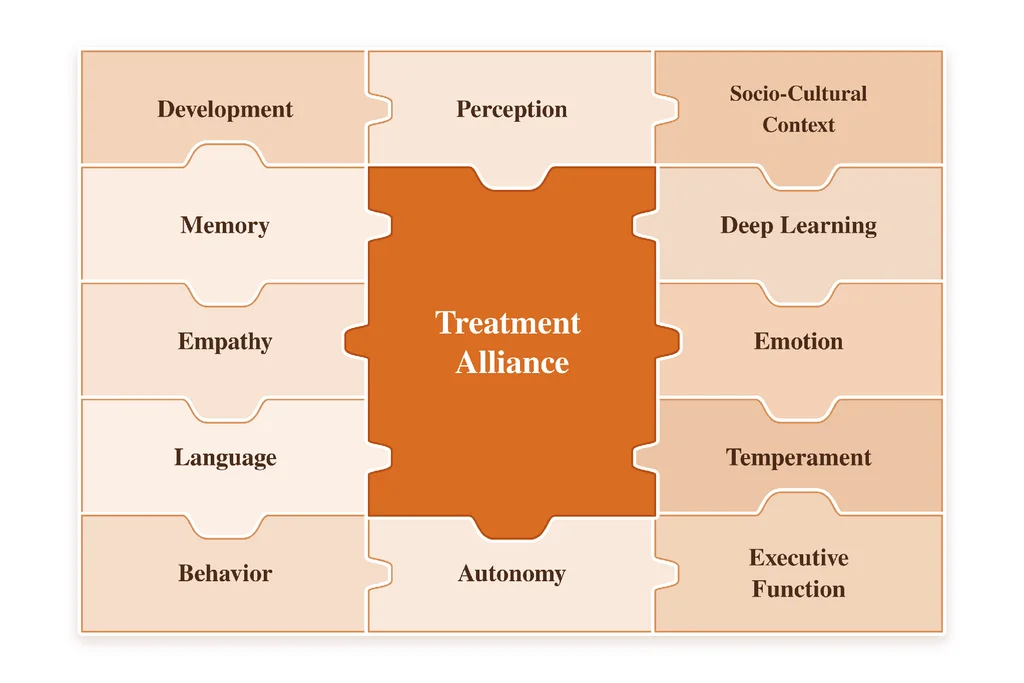
- Treatment Alliance
- The collaborative relationship among client, therapist, family, and other supporters. It sits at the center of the model, because a safe, collaborative relationship supports engagement and change.
- Executive Function
- Managing attention, initiating, planning, organizing, remembering instructions, self-monitoring, controlling responses, and adjusting strategies.
- Memory
- Receiving, storing, organizing, and retrieving information.
- Language
- Understanding and using language to think, communicate, read, and write.
- Perception
- Receiving, organizing, and making sense of information from the environment.
- Development
- The person's developmental stage and readiness across areas.
- Deep Learning
- Moving beyond memorization to understanding, concepts, generalization, and applying knowledge in new situations.
- Autonomy
- Understanding one's own needs, using strategies independently, making decisions, and gradually needing less help.
- Behavior
- Behavior as information about how a person responds to demands, difficulty, and frustration, rather than something to label a "problem".
- Emotion
- Experiences of failure, frustration, or anxiety can affect readiness to learn.
- Temperament
- Individual characteristics in responding to environments and experiences.
- Empathy
- Understanding one's own and others' experiences, and building relationships that support learning.
- Socio-Cultural Context
- Family, school, culture, life experience, and social environment as the context for learning.
No dimension is viewed in isolation. The Educational Therapist works to understand how these factors interact in each individual.
Illustration adapted from The Clinical Practice of Educational Therapy: Learning and Functioning with Diversity (2nd ed., Figure 1.1, p. 13), by M. Ficksman and J. U. Adelizzi, 2018, Routledge.
Every Learner Is Different. So Is Every Program.
There is no single Educational Therapy program for everyone. Programs at Temenos are built individually around each client's needs, profile, strengths, challenges, and circumstances.
In shaping a program, the Educational Therapist considers developmental history and learning experiences, relevant assessment results, patterns of attention and executive functioning, language, memory, and information processing, emotional responses and behavior patterns during learning, level of independence, demands at school, at work, or in daily life, and input from family, teachers, and other professionals.
Goals and strategies are adjusted as the client develops. The therapist watches response patterns, the contexts in which difficulties arise, the level of help needed, and how well strategies work. The program follows the whole person's profile, not simply an age, diagnosis, or grade level.
Session Format
Educational Therapy at Temenos usually takes place one-to-one between the client and the Educational Therapist. In these sessions the therapist can observe and support how a person understands instructions and starts tasks, sustains attention and organizes work, chooses and uses strategies, handles mistakes or change, manages emotional and behavioral responses, asks for help appropriately, solves problems, and evaluates their own work.
One-to-one does not mean every session is always separate from others. When it fits the goals of the intervention, sessions may take place in pairs or small groups. This is planned, weighing each client's profile, readiness, goals, and the group dynamic, and can support communication and social interaction, cooperation and turn-taking, flexibility, joint problem solving, emotional and behavioral regulation in social situations, and using strategies in more natural settings.
Whatever the format, the program stays individualized. Session format, number of participants, activities, and level of support follow each client's needs and goals.
Behavior and Self-Regulation
Behavioral growth can be one of the functional outcomes of Educational Therapy. The therapist can teach strategies that support academic, social, emotional, behavioral, attentional, and metacognitive growth, including many aspects of executive functioning. Executive functions also help a person control impulses, hold goals in mind, use working memory, and adjust actions purposefully, so their development is closely tied to the ability to regulate behavior and emotion (Diamond, 2013).
According to individual need, the therapist may draw on learning and behavior-analytic principles such as antecedent arrangement, positive reinforcement, task analysis, prompting and prompt fading, shaping, teaching replacement behaviors, data-based monitoring, and generalization (Cooper et al., 2020). These principles are used within the broader Educational Therapy framework, with continued attention to cognitive, emotional, developmental, relational, and environmental factors.
The aim is not simply compliance. It is functional skills, self-regulation, and independence: more effective, adaptive, and independent ways of responding to demands.
Educational Therapy Is Not Tutoring
Tutoring generally helps a person understand or catch up on particular material. Educational Therapy examines the processes underneath the difficulty and develops skills so the person can meet similar demands with more effective strategies in the future.
| Aspect | Tutoring | Educational Therapy |
|---|---|---|
| Focus | Particular subjects or material. | The processes underlying learning and functioning. |
| Goal | Understanding, practicing, or catching up on material. | Developing strategies, skills, self-regulation, and independence. |
| Basis of the program | Curriculum, assignments, or academic targets. | The person's profile, needs, strengths, responses, and context. |
| Areas of work | Subject content and academic performance. | Executive functioning, memory, language, metacognition, behavior, self-regulation, problem solving, and autonomy. |
| Expected result | Mastery of current material. | Meeting learning processes and everyday demands with increasing effectiveness and independence. |
Tutoring helps people learn material. Educational Therapy helps people understand and develop how they learn.
Collaboration with Family, School, and Other Professionals
Educational Therapy does not stop at the therapy room door. With the family's consent and according to the client's needs, Temenos may collaborate with schools, teachers, and other professionals: understanding how the person functions in class or in everyday settings, recognizing patterns of difficulty and the supports that work, discussing suitable strategies, accommodations, or modifications, and aligning goals across therapy, home, and school.
Collaboration matters because skills that appear in sessions need to be used with different people, tasks, and environments before they genuinely support everyday life.
School-Based Support Service
According to the client's needs, Temenos provides School-Based Support Service as a service integrated with Educational Therapy. The School Support Professional works alongside the teacher, the school, the family, and the Educational Therapist to help the child take part in learning and to carry out the supports that fit their needs.
The School Support Professional does not replace the teacher and does not take over responsibility for instruction. Decisions about curriculum, teaching, assessment, accommodations, and modifications continue to be discussed with the school and the relevant professionals. The role can include:
- observing the child's participation, needs, and response patterns in class,
- helping carry out accommodations and modifications agreed with the school,
- supporting the child in understanding instructions, starting tasks, organizing work, and using strategies,
- giving help as needed, then gradually reducing it,
- supporting emotional and behavioral regulation with positive, consistent strategies,
- encouraging interaction with teachers and peers without creating dependence on the School Support Professional,
- recording progress and communicating with teachers, the family, and the Educational Therapist.
Support staff can deliver educational strategies effectively when they receive clear direction, training, modeling, feedback, and ongoing supervision (Brock & Carter, 2013). One-to-one support that stays too close can limit independence, so its intensity is reviewed regularly and shifted step by step toward more natural supports from teachers, peers, routines, and the child's own strategies (Scheef et al., 2023).
The ultimate aim is to increase the child's access, participation, self-regulation, and independence in the learning environment. Read the full School-Based Support Service explanation.
What We Aim to Help Develop
Educational Therapy aims to help individuals:
- understand how they learn and recognize their strengths and needs,
- find more effective learning strategies,
- develop executive functioning, metacognition, and self-monitoring,
- improve the ability to organize, start, and complete tasks,
- develop problem solving, cognitive flexibility, and self-regulation,
- respond more adaptively to mistakes, change, and challenges,
- develop functional behaviors such as following routines, asking for help appropriately, and completing tasks,
- build confidence as a learner and self-advocacy,
- use strategies across settings and become increasingly independent in learning and daily life.
Learning Is More Than Academics
At Temenos, learning is understood as a process that involves how a person thinks, remembers, organizes, communicates, feels, regulates behavior, responds to challenges, solves problems, and understands themselves as a learner. Through a safe therapeutic relationship, individualized intervention, an appropriate session format, and collaboration with families and schools, we support each individual to learn and function with greater confidence, effectiveness, and independence.
References
- Brock, M. E., & Carter, E. W. (2013). A systematic review of paraprofessional-delivered educational practices to improve outcomes for students with intellectual and developmental disabilities. Research and Practice for Persons with Severe Disabilities, 38(4), 211–221. https://doi.org/10.1177/154079691303800401
- Cooper, J. O., Heron, T. E., & Heward, W. L. (2020). Applied behavior analysis (3rd ed.). Pearson.
- Diamond, A. (2013). Executive functions. Annual Review of Psychology, 64, 135–168. https://doi.org/10.1146/annurev-psych-113011-143750
- Ficksman, M., & Adelizzi, J. U. (Eds.). (2018). The clinical practice of educational therapy: Learning and functioning with diversity (2nd ed.). Routledge. https://doi.org/10.4324/9781315283371
- Marshall, M., & Rotter, S. (2023). Educational therapy fact sheet [Fact sheet]. Association of Educational Therapists. https://www.aetonline.org/images/ABOUT_Section/Governance_Docs/ET_Fact_Sheet.pdf
- Scheef, A. R., Hollingshead, A., Malone, K., Sherman, W. M., Seamans, A., Sabala, T., & Carson, J. (2023). Increasing the independence of students with disabilities in the classroom through indirect paraprofessional support. TEACHING Exceptional Children, 56(2), 82–88. https://doi.org/10.1177/00400599221143457